- Out of stock


 Payment suited to your country
Delivery in Poland: BLIK or PKO bank transfer. Abroad: Revolut or SEPA transfer in EUR. Full details after placing your order.
 Shipped from Poland
InPost parcel lockers in Poland approx. 72 hours from payment. International letter: Europe approx. 21 days, outside the EU approx. 30 days.
 Any questions?
Write to us via the contact form – please quote your order number.
WARNING: Chemical reagent intended solely for laboratory, research and analytical purposes. NOT FOR HUMAN OR ANIMAL CONSUMPTION. It is not a medicinal product, dietary supplement or food.
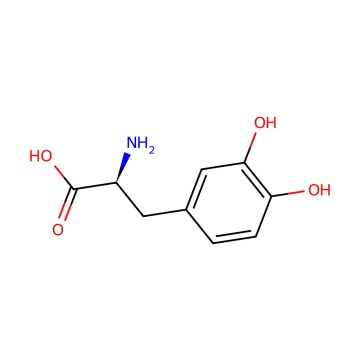
L-DOPA is a naturally occurring amino acid that serves as the direct biosynthetic precursor of dopamine. In living organisms it is formed by hydroxylation of L-tyrosine catalysed by tyrosine hydroxylase, and is subsequently decarboxylated to dopamine. Because of this central position within the catecholamine pathway, the compound is one of the most widely used reference materials in neurochemical and analytical research.
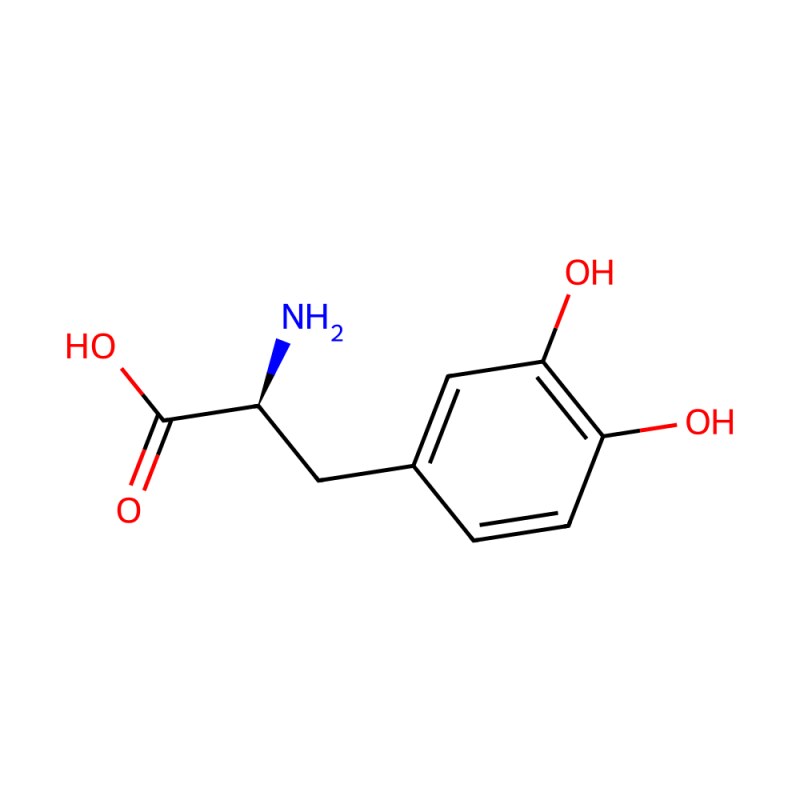
| IUPAC name | (2S)-2-amino-3-(3,4-dihydroxyphenyl)propanoic acid |
| Synonyms | Levodopa, Lewodopa, L-3,4-dihydroxyphenylalanine, L-DOPA |
| CAS number | 59-92-7 |
| Molecular formula | C9H11NO4 |
| Molar mass | 197.19 g/mol |
| Appearance | white to off-white crystalline powder |
| Solubility | poorly soluble in water; more soluble in acidic solutions; practically insoluble in ethanol and diethyl ether |
| Melting point | approx. 276–278 °C (with decomposition) |
| Purity | ≥99% |
L-DOPA is a chiral molecule — only the levorotatory enantiomer (S configuration) is biologically and experimentally relevant, which makes it a useful standard for stereochemical assays and chiral chromatography. Its aromatic ring bears a catechol moiety (two adjacent hydroxyl groups) that is readily oxidised, so the compound is frequently employed as a model substrate in studies of enzymatic reactions involving oxidases, including tyrosinase, and in investigations of melanin formation.
In analytical laboratories L-DOPA is used as a reference standard in HPLC methods with electrochemical and UV detection, in capillary electrophoresis and in mass spectrometry for the determination of catecholamines and their precursors. Thanks to its well-characterised spectral properties (UV absorption, distinctive NMR and IR spectra) it is a convenient calibration material for validating analytical procedures.
In biochemical research the compound is a valued tool for studying the catecholamine biosynthesis pathway, the kinetics of aromatic L-amino acid decarboxylase, and mechanisms of transport across biological membranes. It is also of interest in polydopamine chemistry and biomimetic adhesive coatings, where the reactivity of the catechol group is exploited for surface modification of materials. All of these applications are strictly laboratory and research in nature.
The material should be stored in a tightly closed container, protected from light and moisture, in a cool place, as catechols are prone to oxidation by atmospheric oxygen. Personal protective equipment should be used at all times in accordance with good laboratory practice.
L-DOPA (Levodopa) ≥99% — chemical reagent for laboratory, research and analytical use. Not for human or animal consumption.
5-HTP ≥99% — chemical reagent for laboratory, research and analytical use. Not for human or animal consumption.
Magnesium L-threonate ≥99% — chemical reagent for laboratory, research and analytical use. Not for human or animal consumption.
Melatonin ≥99% — chemical reagent for laboratory, research and analytical use. Not for human or animal consumption.
Tadalafil ≥99% — chemical reagent for laboratory, research and analytical use. Not for human or animal consumption.
Chlodantane (Chlodantan) ≥99% — chemical reagent for laboratory, research and analytical use. Not for human or animal consumption.
Taurine ≥99% — chemical reagent for laboratory, research and analytical use. Not for human or animal consumption.
Mebicar ≥99% — chemical reagent for laboratory, research and analytical use. Not for human or animal consumption.
SLU-PP-332 / SLU-SENSIA — research solution 18 mg in 18 ml DMSO (1.0 mg/ml), CAS 303760-60-3, C18H14N2O2, base substance purity ≥ 98%. For laboratory, research and analytical use only. Not for human or animal consumption.
Pregabalin ≥99% — chemical reagent for laboratory, research and analytical use. Not for human or animal consumption.
Olivetol ≥99% — chemical reagent for laboratory, research and analytical use. Not for human or animal consumption.
Alpha-GPC ≥99% — chemical reagent for laboratory, research and analytical use. Not for human or animal consumption.
Tianeptine (acid) ≥99% — chemical reagent for laboratory, research and analytical use. Not for human or animal consumption.
5-HTP ≥99% — chemical reagent for laboratory, research and analytical use. Not for human or animal consumption.
Noopept ≥99% — chemical reagent for laboratory, research and analytical use. Not for human or animal consumption.
FLUMOLINA ≥99% — chemical reagent for laboratory, research and analytical use. Not for human or animal consumption.
FLModafinil ≥99% — chemical reagent for laboratory, research and analytical use. Not for human or animal consumption.
Sildenafil ≥99% — chemical reagent for laboratory, research and analytical use. Not for human or animal consumption.