- Out of stock

 Payment suited to your country
Delivery in Poland: BLIK or PKO bank transfer. Abroad: Revolut or SEPA transfer in EUR. Full details after placing your order.
 Shipped from Poland
InPost parcel lockers in Poland approx. 72 hours from payment. International letter: Europe approx. 21 days, outside the EU approx. 30 days.
 Any questions?
Write to us via the contact form – please quote your order number.
WARNING: Chemical reagent intended solely for laboratory, research and analytical purposes. NOT FOR HUMAN OR ANIMAL CONSUMPTION. It is not a medicinal product, dietary supplement or food.
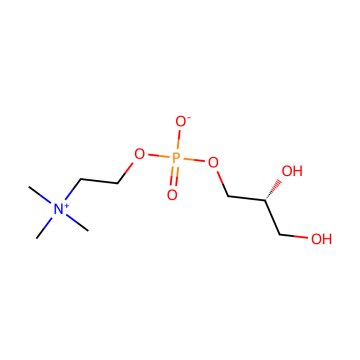
Alpha-GPC is a naturally occurring phospholipid compound belonging to the glycerophosphocholine family — an ester of phosphoric acid, glycerol and choline. In biological systems it acts as an intermediate in phosphatidylcholine metabolism and as a water-soluble carrier of the choline moiety. In laboratory practice it is a valued reference reagent for studies of phospholipid metabolic pathways and as an analytical standard for the determination of choline and its derivatives.
| IUPAC name | [(2R)-2,3-dihydroxypropyl] 2-(trimethylazaniumyl)ethyl phosphate |
| Synonyms | Alpha-GPC, L-α-GPC, choline glycerophosphate, glycerophosphocholine, GPC |
| CAS number | 28319-77-9 |
| Molecular formula | C8H20NO6P |
| Molar mass | 257.22 g/mol |
| Appearance | White to slightly off-white, strongly hygroscopic powder or crystalline solid |
| Solubility | Very soluble in water (approx. 1000 g/L at 25 °C); soluble in methanol and ethanol |
| Melting point | approx. 142–143 °C |
| Purity | ≥99% |
Structurally, Alpha-GPC belongs to the glycerophosphocholines — the molecule combines a glycerol backbone with a phosphate group and the trimethylammonium head of choline. This architecture makes it an amphiphilic compound with a distinct zwitterionic character: the positively charged nitrogen atom coexists with the negatively charged phosphate group. As a result the compound is highly soluble in aqueous media and stable across a broad pH range, which facilitates the preparation of standard solutions.
In a research context Alpha-GPC is used as a model substance in the analysis of phospholipid metabolic pathways and as a choline-moiety donor in in-vitro enzymatic systems. It also serves as a reference standard in chromatographic methods (HPLC, LC-MS) and NMR spectroscopy, where it aids the calibration and identification of choline derivatives. In biochemistry laboratories it is employed in the preparation of buffers and reference mixtures when assaying the activity of phospholipases and enzymes involved in phosphatidylcholine turnover.
Owing to its pronounced hygroscopicity the product should be stored in a tightly sealed container, in a dry place, away from moisture and heat sources; the use of a desiccant is recommended. Weighing should be performed quickly to limit absorption of atmospheric moisture, which can affect the accuracy of the sample mass. The material is intended solely for laboratory and analytical applications carried out by qualified personnel using appropriate personal protective equipment.
Alpha-GPC ≥99% — chemical reagent for laboratory, research and analytical use. Not for human or animal consumption.
Olivetol ≥99% — chemical reagent for laboratory, research and analytical use. Not for human or animal consumption.
FLUMOLINA ≥99% — chemical reagent for laboratory, research and analytical use. Not for human or animal consumption.
Paracetamol ≥99% — chemical reagent for laboratory, research and analytical use. Not for human or animal consumption.
Magnesium L-threonate ≥99% — chemical reagent for laboratory, research and analytical use. Not for human or animal consumption.
Melatonin ≥99% — chemical reagent for laboratory, research and analytical use. Not for human or animal consumption.
Caffeine ≥99% — chemical reagent for laboratory, research and analytical use. Not for human or animal consumption.
MODANA ≥99% — chemical reagent for laboratory, research and analytical use. Not for human or animal consumption.
Noopept ≥99% — chemical reagent for laboratory, research and analytical use. Not for human or animal consumption.
Hemantane ≥99% — chemical reagent for laboratory, research and analytical use. Not for human or animal consumption.
Modafinil ≥99% — chemical reagent for laboratory, research and analytical use. Not for human or animal consumption.
Pregabalin ≥99% — chemical reagent for laboratory, research and analytical use. Not for human or animal consumption.
Tianeptine (acid) ≥99% — chemical reagent for laboratory, research and analytical use. Not for human or animal consumption.
Bromantan ≥99% — chemical reagent for laboratory, research and analytical use. Not for human or animal consumption.
Mebicar ≥99% — chemical reagent for laboratory, research and analytical use. Not for human or animal consumption.
Chlodantane (Chlodantan) ≥99% — chemical reagent for laboratory, research and analytical use. Not for human or animal consumption.
5-HTP ≥99% — chemical reagent for laboratory, research and analytical use. Not for human or animal consumption.