

 Payment suited to your country
Delivery in Poland: BLIK or PKO bank transfer. Abroad: Revolut or SEPA transfer in EUR. Full details after placing your order.
 Shipped from Poland
InPost parcel lockers in Poland approx. 72 hours from payment. International letter: Europe approx. 21 days, outside the EU approx. 30 days.
 Any questions?
Write to us via the contact form – please quote your order number.
WARNING: Chemical reagent intended solely for laboratory, research and analytical purposes. NOT FOR HUMAN OR ANIMAL CONSUMPTION. It is not a medicinal product, dietary supplement or food.
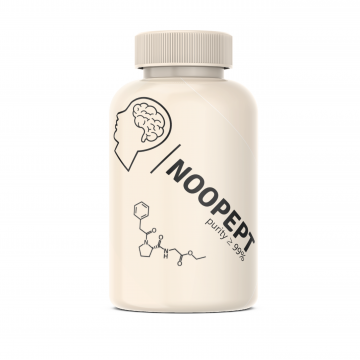
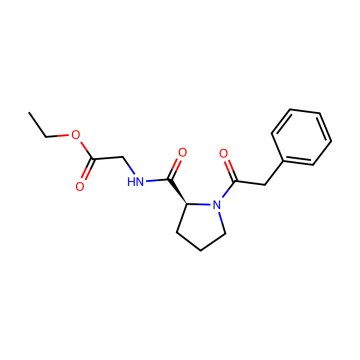
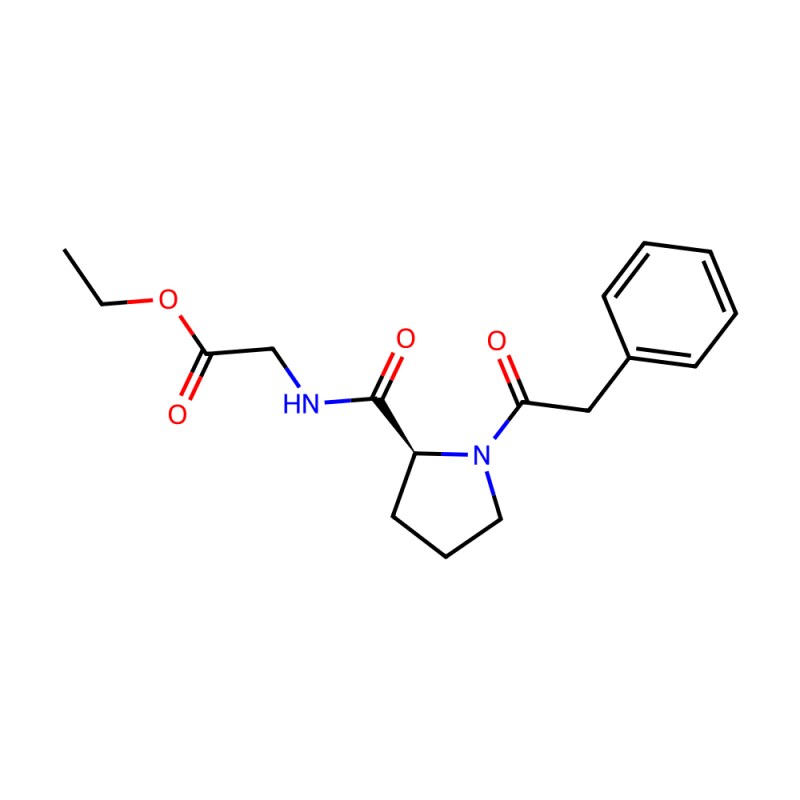
Noopept is a synthetic dipeptide compound belonging to the class of nootropic substances studied in the biomedical sciences. Structurally it is the ethyl ester of N-phenylacetyl-L-prolylglycine — combining a phenylacetyl residue with a proline–glycine dipeptide. The molecule is sometimes described as a derivative designed for increased lipophilicity relative to the racetam scaffold, although chemically it represents a distinct dipeptide class. Owing to its well-defined structure and high activity in laboratory models, it is a frequent subject of in vitro neuropharmacological research.
| IUPAC name | ethyl 2-[[(2S)-1-(2-phenylacetyl)pyrrolidine-2-carbonyl]amino]acetate |
| Synonyms | Noopept, GVS-111, N-phenylacetyl-L-prolylglycine ethyl ester, omberacetam |
| CAS number | 157115-85-0 |
| Molecular formula | C17H22N2O4 |
| Molar mass | 318.37 g/mol |
| Appearance | white to off-white crystalline powder |
| Solubility | poorly soluble in water; soluble in ethanol and DMSO |
| Melting point | no consistent literature data |
| Purity | ≥99% |
Noopept contains a stereocentre in the pyrrolidine ring derived from L-proline, making it an optically active compound and a relevant reference point in enantiomeric purity analysis. The presence of ester and amide bonds governs its characteristic reactivity — the ester group is susceptible to hydrolysis in aqueous and enzymatic environments, so the compound is used as a model in studies of peptidomimetic stability and hydrolysis kinetics.
In analytical laboratories Noopept serves as a reference standard in liquid chromatography (HPLC, UPLC) coupled with UV detection and mass spectrometry, where its well-defined molecular mass and characteristic fragmentation facilitate identification and quantification. The material is used in the development and validation of analytical methods, quality control, and studies of dipeptide metabolism.
In neurobiology and experimental pharmacology, Noopept is the subject of work on mechanisms of synaptic plasticity, neurotrophic activity, and signalling pathways in cell cultures and animal models. It is employed as a tool for investigating peptidergic regulatory systems and in structure–activity relationship studies within peptidomimetic compounds. All applications are strictly research and laboratory in nature; this description contains no health recommendations or dosage information.
Because of the ester bond, storage in a tightly closed container at low temperature, away from moisture and light, is recommended to limit the risk of hydrolysis. Personal protective equipment should be used at all times in accordance with good laboratory practice.
Noopept ≥99% — chemical reagent for laboratory, research and analytical use. Not for human or animal consumption.
Sunifiram ≥99% — chemical reagent for laboratory, research and analytical use. Not for human or animal consumption.
L-DOPA (Levodopa) ≥99% — chemical reagent for laboratory, research and analytical use. Not for human or animal consumption.
Bromantan ≥99% — chemical reagent for laboratory, research and analytical use. Not for human or animal consumption.
Tianeptine (acid) ≥99% — chemical reagent for laboratory, research and analytical use. Not for human or animal consumption.
FLUMOLINA ≥99% — chemical reagent for laboratory, research and analytical use. Not for human or animal consumption.
Tadalafil ≥99% — chemical reagent for laboratory, research and analytical use. Not for human or animal consumption.
Sildenafil ≥99% — chemical reagent for laboratory, research and analytical use. Not for human or animal consumption.
Magnesium L-threonate ≥99% — chemical reagent for laboratory, research and analytical use. Not for human or animal consumption.
FLModafinil ≥99% — chemical reagent for laboratory, research and analytical use. Not for human or animal consumption.
5-HTP ≥99% — chemical reagent for laboratory, research and analytical use. Not for human or animal consumption.
Chlodantane (Chlodantan) ≥99% — chemical reagent for laboratory, research and analytical use. Not for human or animal consumption.
Pregabalin ≥99% — chemical reagent for laboratory, research and analytical use. Not for human or animal consumption.
Caffeine ≥99% — chemical reagent for laboratory, research and analytical use. Not for human or animal consumption.
Modafinil ≥99% — chemical reagent for laboratory, research and analytical use. Not for human or animal consumption.
Taurine ≥99% — chemical reagent for laboratory, research and analytical use. Not for human or animal consumption.
Alpha-GPC ≥99% — chemical reagent for laboratory, research and analytical use. Not for human or animal consumption.
Melatonin ≥99% — chemical reagent for laboratory, research and analytical use. Not for human or animal consumption.