- New

 Payment suited to your country
Delivery in Poland: BLIK or PKO bank transfer. Abroad: Revolut or SEPA transfer in EUR. Full details after placing your order.
 Shipped from Poland
InPost parcel lockers in Poland approx. 72 hours from payment. International letter: Europe approx. 21 days, outside the EU approx. 30 days.
 Any questions?
Write to us via the contact form – please quote your order number.
WARNING: Chemical reagent intended solely for laboratory, research and analytical purposes. NOT FOR HUMAN OR ANIMAL CONSUMPTION. It is not a medicinal product, dietary supplement or food.
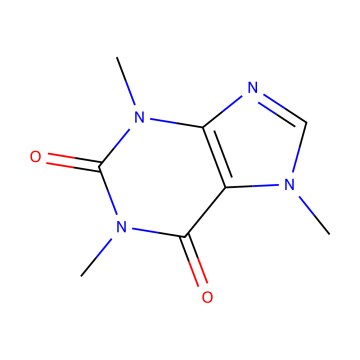
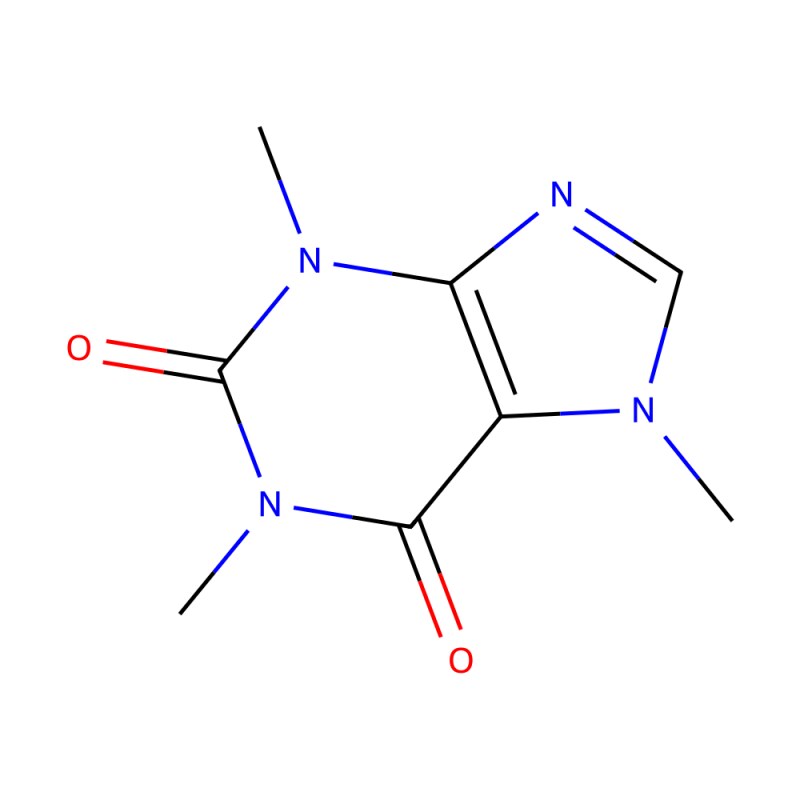
Caffeine is a purine alkaloid of the methylxanthine group, formally 1,3,7-trimethyl-3,7-dihydro-1H-purine-2,6-dione. Its molecule is built on a bicyclic purine framework in which three nitrogen atoms bear methyl groups, and the system contains two carbonyl groups. Caffeine is among the best-characterised organic compounds, with well-documented spectral, thermal and chromatographic properties, which makes it one of the most frequently used analytical standards in laboratories.
The supplied material is a white, odourless crystalline powder with a bitter taste and high declared purity. Owing to its reproducible physicochemical properties and stability under normal conditions, caffeine is a convenient and inexpensive reference substance used in quality control and in analytical chemistry teaching.
| Systematic name (IUPAC) | 1,3,7-trimethyl-3,7-dihydro-1H-purine-2,6-dione |
| Synonyms | caffeine, theine, guaranine, 1,3,7-trimethylxanthine |
| CAS number | 58-08-2 |
| Molecular formula | C8H10N4O2 |
| Molar mass | 194.19 g/mol |
| Appearance | white, odourless crystalline powder |
| Solubility | moderately soluble in water (better in hot water); soluble in chloroform |
| Melting point | approx. 235 °C (with sublimation) |
| Purity | ≥99% |
Caffeine is one of the most popular standards in analytical chemistry. In UV spectrophotometry it shows a characteristic absorption maximum around 273 nm, which makes it a frequent calibration standard in quantitative assay methods. In liquid chromatography (HPLC) and thin-layer chromatography (TLC), caffeine is used as a retention marker and as a standard for method validation and for checking the reproducibility of separation systems.
In quality-control laboratories, caffeine serves as a reference substance when determining its content in food, beverage and plant-material samples by instrumental methods. It is also a model analyte in educational work illustrating the extraction, crystallisation and sublimation of organic compounds, and its well-known thermal properties make it a useful standard in thermogravimetric analysis (TGA) and differential scanning calorimetry (DSC). All applications are strictly research and analytical in nature. The product should be stored in a dry place, in a tightly closed container, away from moisture. The material is not intended for consumption or for any use on living organisms.
Caffeine ≥99% — chemical reagent for laboratory, research and analytical use. Not for human or animal consumption.
Bromantan ≥99% — chemical reagent for laboratory, research and analytical use. Not for human or animal consumption.
Olivetol ≥99% — chemical reagent for laboratory, research and analytical use. Not for human or animal consumption.
FLUMOLINA ≥99% — chemical reagent for laboratory, research and analytical use. Not for human or animal consumption.
MODANA ≥99% — chemical reagent for laboratory, research and analytical use. Not for human or animal consumption.
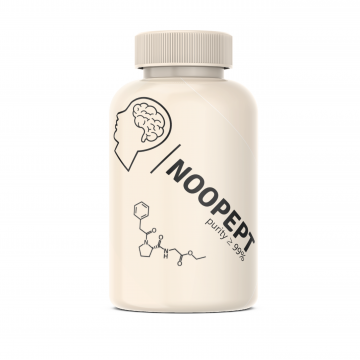
Noopept ≥99% — chemical reagent for laboratory, research and analytical use. Not for human or animal consumption.
Alpha-GPC ≥99% — chemical reagent for laboratory, research and analytical use. Not for human or animal consumption.
Magnesium L-threonate ≥99% — chemical reagent for laboratory, research and analytical use. Not for human or animal consumption.
Taurine ≥99% — chemical reagent for laboratory, research and analytical use. Not for human or animal consumption.
Sildenafil ≥99% — chemical reagent for laboratory, research and analytical use. Not for human or animal consumption.
Mebicar ≥99% — chemical reagent for laboratory, research and analytical use. Not for human or animal consumption.
Tadalafil ≥99% — chemical reagent for laboratory, research and analytical use. Not for human or animal consumption.
Hemantane ≥99% — chemical reagent for laboratory, research and analytical use. Not for human or animal consumption.
Melatonin ≥99% — chemical reagent for laboratory, research and analytical use. Not for human or animal consumption.
SLU-PP-332 / SLU-SENSIA — research solution 18 mg in 18 ml DMSO (1.0 mg/ml), CAS 303760-60-3, C18H14N2O2, base substance purity ≥ 98%. For laboratory, research and analytical use only. Not for human or animal consumption.
Pregabalin ≥99% — chemical reagent for laboratory, research and analytical use. Not for human or animal consumption.
Chlodantane (Chlodantan) ≥99% — chemical reagent for laboratory, research and analytical use. Not for human or animal consumption.