- New

 Payment suited to your country
Delivery in Poland: BLIK or PKO bank transfer. Abroad: Revolut or SEPA transfer in EUR. Full details after placing your order.
 Shipped from Poland
InPost parcel lockers in Poland approx. 72 hours from payment. International letter: Europe approx. 21 days, outside the EU approx. 30 days.
 Any questions?
Write to us via the contact form – please quote your order number.
WARNING: Chemical reagent intended solely for laboratory, research and analytical purposes. NOT FOR HUMAN OR ANIMAL CONSUMPTION. It is not a medicinal product, dietary supplement or food.
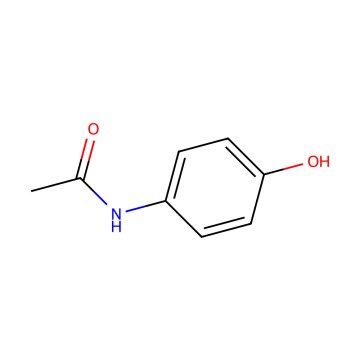
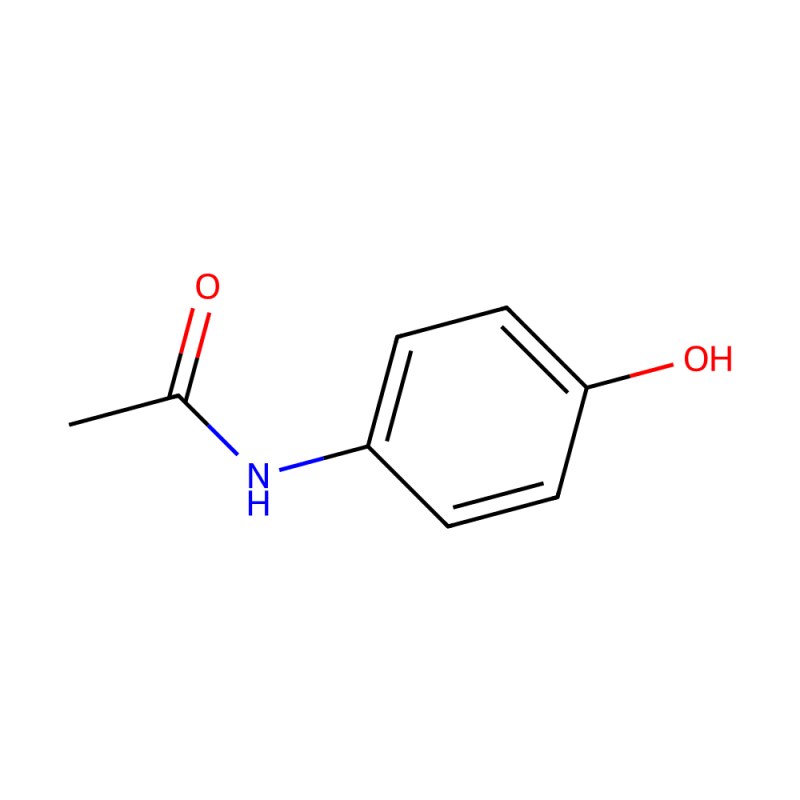
Paracetamol (acetaminophen, 4-acetamidophenol) is an organic amide compound and a derivative of aniline. The molecule consists of an aromatic ring substituted with a hydroxyl group and an acetamido group, making it a classic representative of para-aminophenol phenolic compounds. As a laboratory reagent, paracetamol is one of the most frequently used reference substances in analytical chemistry and pharmaceutical qualitative analysis. The material offered here has a declared purity of ≥99%, making it an excellent reference standard for quantitative and validation methods.
| IUPAC name | N-(4-hydroxyphenyl)acetamide |
| Synonyms | paracetamol, acetaminophen, 4-acetamidophenol, APAP, N-acetyl-para-aminophenol |
| CAS number | 103-90-2 |
| Molecular formula | C8H9NO2 |
| Molar mass | 151.16 g/mol |
| Appearance | white crystalline powder |
| Solubility | moderately soluble in water (better in hot water); freely soluble in ethanol, methanol and acetone |
| Melting point | approx. 168–172 °C |
| Boiling point | no data (decomposes before boiling) |
| Purity | ≥99% |
Paracetamol is one of the most widely used reference compounds in liquid chromatography (HPLC) and UV spectrophotometry, where its well-defined absorption spectrum makes it an ideal standard for calibration and system-suitability testing. In analytical chemistry and quality control, the compound serves as a reference material for quantitative determinations and in studies of the purity and identification of phenolic substances. Owing to the presence of phenolic and amide groups, paracetamol is a useful model in studies of oxidation reactions, amide hydrolysis and the stability of aromatic compounds under various pH and temperature conditions. It is also used in research on crystal polymorphism and as a model substance in studies of the solubility and dissolution of solids. The material is intended solely for laboratory work carried out by qualified personnel with appropriate protective measures. Storage in a tightly sealed container, in a dry and cool place, away from moisture and strong oxidisers, is recommended to preserve the declared purity and stability of the reagent.
Paracetamol ≥99% — chemical reagent for laboratory, research and analytical use. Not for human or animal consumption.
Sunifiram ≥99% — chemical reagent for laboratory, research and analytical use. Not for human or animal consumption.
MODANA ≥99% — chemical reagent for laboratory, research and analytical use. Not for human or animal consumption.
FLModafinil ≥99% — chemical reagent for laboratory, research and analytical use. Not for human or animal consumption.
Sildenafil ≥99% — chemical reagent for laboratory, research and analytical use. Not for human or animal consumption.
Melatonin ≥99% — chemical reagent for laboratory, research and analytical use. Not for human or animal consumption.
Alpha-GPC ≥99% — chemical reagent for laboratory, research and analytical use. Not for human or animal consumption.
Pregabalin ≥99% — chemical reagent for laboratory, research and analytical use. Not for human or animal consumption.
Noopept ≥99% — chemical reagent for laboratory, research and analytical use. Not for human or animal consumption.
Modafinil ≥99% — chemical reagent for laboratory, research and analytical use. Not for human or animal consumption.
5-HTP ≥99% — chemical reagent for laboratory, research and analytical use. Not for human or animal consumption.
Hemantane ≥99% — chemical reagent for laboratory, research and analytical use. Not for human or animal consumption.
Magnesium L-threonate ≥99% — chemical reagent for laboratory, research and analytical use. Not for human or animal consumption.
L-DOPA (Levodopa) ≥99% — chemical reagent for laboratory, research and analytical use. Not for human or animal consumption.
Bromantan ≥99% — chemical reagent for laboratory, research and analytical use. Not for human or animal consumption.
Caffeine ≥99% — chemical reagent for laboratory, research and analytical use. Not for human or animal consumption.
Tianeptine (acid) ≥99% — chemical reagent for laboratory, research and analytical use. Not for human or animal consumption.