- New

 Payment suited to your country
Delivery in Poland: BLIK or PKO bank transfer. Abroad: Revolut or SEPA transfer in EUR. Full details after placing your order.
 Shipped from Poland
InPost parcel lockers in Poland approx. 72 hours from payment. International letter: Europe approx. 21 days, outside the EU approx. 30 days.
 Any questions?
Write to us via the contact form – please quote your order number.
WARNING: Chemical reagent intended solely for laboratory, research and analytical purposes. NOT FOR HUMAN OR ANIMAL CONSUMPTION. It is not a medicinal product, dietary supplement or food.
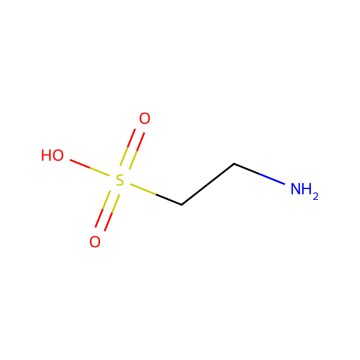
Taurine (2-aminoethanesulfonic acid) is an organic sulfonic acid bearing an amino group and is one of the few naturally occurring sulfonic amino acids. Unlike classic proteinogenic amino acids, in the taurine molecule the carboxyl group is replaced by a strongly acidic sulfonic group, giving the compound distinctive physicochemical properties. As a laboratory reagent, taurine is used in analytical chemistry, biochemistry and as a buffer component. The material offered here has a declared purity of ≥99%, ensuring high reproducibility in quantitative and preparative applications.
| IUPAC name | 2-aminoethane-1-sulfonic acid |
| Synonyms | taurine, 2-aminoethanesulfonic acid, tauric acid |
| CAS number | 107-35-7 |
| Molecular formula | C2H7NO3S |
| Molar mass | 125.15 g/mol |
| Appearance | white crystalline powder |
| Solubility | freely soluble in water; practically insoluble in ethanol and non-polar organic solvents |
| Melting point | approx. 305–310 °C (with decomposition) |
| Boiling point | no data (decomposes before boiling) |
| Purity | ≥99% |
Taurine is widely used in laboratories as a buffer and culture-medium component and as an analytical standard in amino-acid determinations by liquid chromatography and electrophoresis. Owing to the strongly acidic character of its sulfonic group and its good water solubility, the compound is employed in studies of acid-base equilibria and the properties of zwitterions. In biochemistry, taurine serves as a model material in studies of osmolyte transport and macromolecule stabilisation, while in analytical chemistry it is used as a standard for validating methods for determining sulfonic-group-containing compounds. Taurine is also used as an auxiliary reagent in organic synthesis and in the preparation of pH-controlled buffers. The material is intended solely for laboratory work carried out by qualified personnel with appropriate precautions. Storage in a tightly sealed container, in a dry place, away from moisture and strong oxidisers, is recommended to maintain the declared purity and stability of the reagent throughout its analytical shelf life.
Taurine ≥99% — chemical reagent for laboratory, research and analytical use. Not for human or animal consumption.
FLModafinil ≥99% — chemical reagent for laboratory, research and analytical use. Not for human or animal consumption.
Noopept ≥99% — chemical reagent for laboratory, research and analytical use. Not for human or animal consumption.
Bromantan ≥99% — chemical reagent for laboratory, research and analytical use. Not for human or animal consumption.
Magnesium L-threonate ≥99% — chemical reagent for laboratory, research and analytical use. Not for human or animal consumption.
Melatonin ≥99% — chemical reagent for laboratory, research and analytical use. Not for human or animal consumption.
5-HTP ≥99% — chemical reagent for laboratory, research and analytical use. Not for human or animal consumption.
SLU-PP-332 / SLU-SENSIA — research solution 18 mg in 18 ml DMSO (1.0 mg/ml), CAS 303760-60-3, C18H14N2O2, base substance purity ≥ 98%. For laboratory, research and analytical use only. Not for human or animal consumption.
Hemantane ≥99% — chemical reagent for laboratory, research and analytical use. Not for human or animal consumption.
FLUMOLINA ≥99% — chemical reagent for laboratory, research and analytical use. Not for human or animal consumption.
Alpha-GPC ≥99% — chemical reagent for laboratory, research and analytical use. Not for human or animal consumption.
Paracetamol ≥99% — chemical reagent for laboratory, research and analytical use. Not for human or animal consumption.
Tianeptine (acid) ≥99% — chemical reagent for laboratory, research and analytical use. Not for human or animal consumption.
Caffeine ≥99% — chemical reagent for laboratory, research and analytical use. Not for human or animal consumption.
Sunifiram ≥99% — chemical reagent for laboratory, research and analytical use. Not for human or animal consumption.
L-DOPA (Levodopa) ≥99% — chemical reagent for laboratory, research and analytical use. Not for human or animal consumption.
Sildenafil ≥99% — chemical reagent for laboratory, research and analytical use. Not for human or animal consumption.