- New
- Out of stock

 Payment suited to your country
Delivery in Poland: BLIK or PKO bank transfer. Abroad: Revolut or SEPA transfer in EUR. Full details after placing your order.
 Shipped from Poland
InPost parcel lockers in Poland approx. 72 hours from payment. International letter: Europe approx. 21 days, outside the EU approx. 30 days.
 Any questions?
Write to us via the contact form – please quote your order number.
WARNING: Chemical reagent intended solely for laboratory, research and analytical purposes. NOT FOR HUMAN OR ANIMAL CONSUMPTION. It is not a medicinal product, dietary supplement or food.
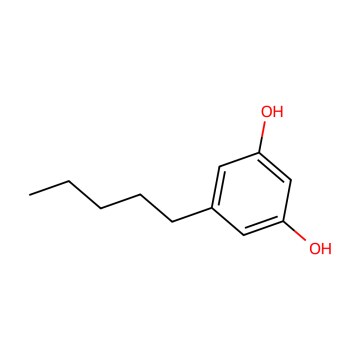
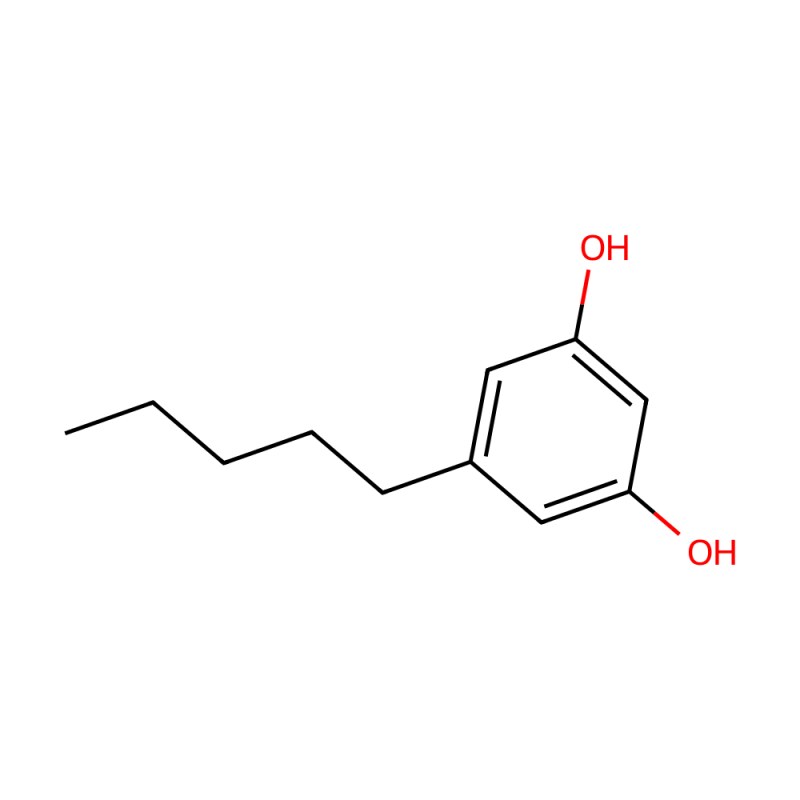
Olivetol is an organic compound of the alkylresorcinol group, formally 5-pentylbenzene-1,3-diol. Its molecule is a resorcinol ring (benzene-1,3-diol) bearing a straight-chain pentyl substituent at position 5. The presence of two phenolic hydroxyl groups in the meta position (1,3) together with an alkyl chain gives the compound both the reactivity characteristic of phenols and a degree of lipophilicity, making it a useful and versatile building block in organic synthesis.
The supplied material is purified olivetol of high declared purity, usually occurring as a viscous, pale oil or a low-melting solid ranging from colourless to pale yellow. Olivetol is a classic precursor and reference compound in resorcinol chemistry and in work on the synthesis of phenolic derivatives.
| Systematic name (IUPAC) | 5-pentylbenzene-1,3-diol |
| Synonyms | Olivetol, 5-pentylresorcinol, 5-amylresorcinol |
| CAS number | 500-66-3 |
| Molecular formula | C11H16O2 |
| Molar mass | 180.24 g/mol |
| Appearance | colourless or pale yellow solid / viscous oil |
| Solubility | soluble in ethanol, methanol and diethyl ether; poorly soluble in water |
| Melting point | no reliable data — omitted (material is often semi-solid) |
| Purity | ≥99% |
Olivetol is a valued building block in organic synthesis, primarily as a precursor in resorcinol chemistry. Its electron-rich aromatic ring readily undergoes electrophilic aromatic substitution, Friedel-Crafts alkylation and condensation reactions, which makes the compound a convenient substrate in multi-step synthetic sequences and in studies of alkylresorcinol chemistry.
In the laboratory, olivetol is used as an analytical standard and model compound in HPLC, GC-MS and NMR spectroscopy studies, where it serves for method validation and the identification of phenolic derivatives. It is also applied in natural product chemistry research and as a reference reagent in the development of procedures for determining alkylresorcinols in plant samples. Because of its phenolic groups, the material is sensitive to oxidation — it should be stored in a cool place, in a tightly closed container, protected from light and air, preferably under an inert gas atmosphere. All applications are strictly research in nature; the product is not intended for use on living organisms.
Olivetol ≥99% — chemical reagent for laboratory, research and analytical use. Not for human or animal consumption.
Bromantan ≥99% — chemical reagent for laboratory, research and analytical use. Not for human or animal consumption.
FLUMOLINA ≥99% — chemical reagent for laboratory, research and analytical use. Not for human or animal consumption.
Alpha-GPC ≥99% — chemical reagent for laboratory, research and analytical use. Not for human or animal consumption.
Melatonin ≥99% — chemical reagent for laboratory, research and analytical use. Not for human or animal consumption.
Tadalafil ≥99% — chemical reagent for laboratory, research and analytical use. Not for human or animal consumption.
Mebicar ≥99% — chemical reagent for laboratory, research and analytical use. Not for human or animal consumption.
FLModafinil ≥99% — chemical reagent for laboratory, research and analytical use. Not for human or animal consumption.
Modafinil ≥99% — chemical reagent for laboratory, research and analytical use. Not for human or animal consumption.
Caffeine ≥99% — chemical reagent for laboratory, research and analytical use. Not for human or animal consumption.
Sildenafil ≥99% — chemical reagent for laboratory, research and analytical use. Not for human or animal consumption.
Pregabalin ≥99% — chemical reagent for laboratory, research and analytical use. Not for human or animal consumption.
Tianeptine (acid) ≥99% — chemical reagent for laboratory, research and analytical use. Not for human or animal consumption.
Chlodantane (Chlodantan) ≥99% — chemical reagent for laboratory, research and analytical use. Not for human or animal consumption.
Hemantane ≥99% — chemical reagent for laboratory, research and analytical use. Not for human or animal consumption.
L-DOPA (Levodopa) ≥99% — chemical reagent for laboratory, research and analytical use. Not for human or animal consumption.
MODANA ≥99% — chemical reagent for laboratory, research and analytical use. Not for human or animal consumption.